Friday, July 13, 2012

Report for the health camp

Mobile health camp 2012 - An international volunteer’s perspective.

Ben McKinnel.

I was lucky enough to be invited to assist on a mobile health camp from the 29th June till 9th July 2012. The aim of these camps is provide basic healthcare to poor and marginalized areas of Nepal where these services are sadly lacking. The camp was organized by CDRA-nepal, a local grassroots style NGO with the Rotary club of Dhulikhel and was funded by the Goodwill Community Foundation. The team consisted of an eye team, a general health team, a women's health team, a dental team and a pharmacy team. There were also three international volunteers from New Zealand and two nursing students from Canada. On the 29th we all packed into our bus and headed off on the 14 hour bus ride to Tansen, in the Palpa reigon.

The first two days of camp were in Argali, a small village nestled in a valley around 1 hours drive from Tansen. The village is surrounded by steep bush-clad hills that would all be called mountains anywhere else in the world. As we arrived the hills were shrouded in mist and the cool peacefulness made a refreshing change from the hustle and heat in the city. We were officially welcomed into the small school that was to be our base for the next two days. The facilities were basic, with small rooms without electricity but clean and perfectly acceptable. All the different teams were assigned a classroom each to work from with the camp using all the rooms of the small school. For most of the camp I was helping out in the eye team, I have a small amount of experience in screening and assisting the opticians and felt that I could be the most use here. There were originally two optometrists scheduled to be on camp but one had to withdraw at the last minute due to family bereavement. Deniesh, the remaining optometrist did a sterling job seeing the multitudes of patients, often working through tea breaks. Many of the eye patients were elderly people suffering from cataract blindness and the local Rotary club of Tansen had arranged funding for 12 surgeries at the local hospital located in Tansen. Sadly this was no was near enough as we 25 cases of cataract blindness on the first day alone. Some other common eye complaints were children with very weak eyes, infections and allergies. The infections were referred to hospital for more in depth treatment and the children were prescribed glasses that were supplied at a highly subsidized rate. I think these glasses will make a huge impact on the childrens ability to learn and therefore their prospects for higher education. We were fed local food of Dhal Bhaat cooked by local volunteers and billeted in wonderful homestays for the night, where our hosts informed us that Argali has a population of around 9000 with only a local health post staffed by two nurses.    
After two days enjoying the wonderful hospitality of the folks in Argali we headed off to Butwal. Butwal is a large city located on the Terai or plains area of Nepal. Effectively an extension on the great northern Indian plains the Terai was sweltering in the summer heat, sitting at around 35 degrees Celsius with very high humidity. We were well looked after by the Rotary club of Butwal, in fact one of the strengths of this camp was utilizing local Rotary club as facilitators. The motivated locals were able to make local arrangements and mobilize their Rotary Community Corps (RCC) to help with the many tasks required to accommodate and feed a large team. We stayed in the city and headed out for two days of camp in two separate locations. The first was in the village of Saina Maina. Not far from Butwal and on a major road, therefore serving a large population. There are areas of relative wealth beside areas of absolute poverty. Many of our patients here were from the Dailit or untouchable caste. I touched several throughout the day and my hand didn't fall off or anything. The camp used one classroom block of a large school complex. During the lunch breaks we were swamped by school kids curious to see what was going on. We were able to screen many of these kids and pick up several who were in need of glasses. Many of these children would have never been picked up otherwise. The women's health team had a busy day on this day, However I kept away from their rooms  figuring that the last thing they needed was a 6 foot 3 foreigner making the patients nervous. By this stage some of the new volunteers were up to speed with the eye testing and I was able to get a look at some of the other teams. This was very interesting even if I wasn't very helpful.
The second of these days was at the tiny village of Amrath Kopibastu. This small plains village is located well off any main roads, we had to walk the last couple of kilometers as the bus wasn't going to make it over some very rickety bridges. The difference being on a main road makes was obvious as the community was noticeably poorer than the previous day with most of the houses being small mud huts with thatched roofs. We set up in a small school quickly as we had our systems well sussed by now. As word spread through the small community many people began to arrive, in fact this was one of our busiest days yet. The people are mainly from the Tharu caste which is a marginalized community in Nepali society. The Tharu people are among the original inhabitants of the Terai reigon as they have a natural immunity to malaria. As malaria becomes less of a problem due to pesticides and drugs, the Tharu are slowly being pushed off their fertile farmlands.  We had some communication problems as many of the villagers only spoke the Tharu language and not the official Nepali.  We really felt we were needed in this village as these people are often reluctant to seek medical help in town as they fear it will be too expensive and they are unaware of many treatment possibilities. There were many people keen for eye treatment as many people regard their eyesight as their greatest asset and fear losing it above all else. We were told by one local that they can make do with almost anything except the loss of eyesight and this is when they become a burden on their families. Eye problems are common here due to the massive amounts of dust and contaminates in the atmosphere. All the teams had a busy day and felt very appreciated. We sadly said goodbye to Gennie and Michelle, our volunteers from Canada and packed back up and headed up to the Dang area in our trusty bus.    

Dang is a poor area in the mid west Nepal, while slightly higher than the Terai it has a similar climate and is famous for its hot, sticky summers. We spent the first two days in Dang based in Gorahi, the main city for the area. From our hotel we went to the campsite, a large secondary school on the outskirts of town in the area of Narayam.  This school of over 2400 students didn't have any running water and the toilets were not for the faint of heart! The area is on the outskirts of town and therefore highly populated and we saw a mix of farmers and in town laborers. The monsoon caught up with us on these days and it was sad to see the patients lining up in the torrential downpours but not be willing to give up on their chance at healthcare.  We worked as fast as possible to try to keep the lines down but more and more kept coming. Still at least the rain kept the temperature down. On the second day here a woman who had been seen by the doctors collapsed shortly afterwards. It turns out that she had decided to take all the prescribed pills at once despite being expressly told not to. She made a full recovery. Sadly this attitude seems quite prevalent due to lack of education. Many people think 'if one pill is good then 10 pills must be 10 times better'. We were more vigilant about stressing the importance of following prescriptions after that. Another interesting patient was a young man with facial injuries after a vehicle hijacking. He was very shaken and taken to local hospital for x-rays. At the end of our time here Ashok made a generous donation of a water tank for the school on behalf of the Rotary club of Dhulikhel. This will help with the current water problem the school is facing. 
For our final two days we headed on a short drive to Tulsipur, the other large city in Dang. We were stoked to find our hotel for the next couple of days had a swimming pool, just the thing to combat the hot sticky weather. Our camp was located off the beaten track in another small village of Kashipur. Again this is predominantly a Tharu village with farming small plots of land the main occupation. There we had an unusual case of one man who tried some self-medication. He had been suffering from itching in his eyes and in Nepali folklore it is said that eating chilies is good for your eyes. This guy tried to bypass the eating part and rubbed chili paste directly into his eyes. This is not something he would recommend as it turns out. I also took the chance to attempt to plow a field in the local style with a wooden plow pulled by two bulls. I think the bulls didn’t understand English very well as the results left a lot to be desired. At least everyone had a laugh, even if I think next time I’ll stick to a John Deere. We located three cases in this village that we decided to take back to Kathmandu for further treatment. One is an eight year old boy with facial disfiguration and poor eyesight. He and his father came for the 17 hour bus ride home with us to see a specialist. He said he will perform the operation free of charge but they must wait until the boy is twelve for the muscles to develop. Another was a girl who had a cataract from a young age and had already received surgery. However the surgeon made a mistake and we took her and her father on the bus to see the specialist also. Sadly it was inoperable and the also returned home. The third girl had a large cyst on her abdomen that was immediately called life threatening by the doctors. As we were returning to Kathmandu the next day we took her and her father with us also. She is currently recovering post op very nicely in Dhulikhel hospital.

Thursday, July 12, 2012

Photos of health camp


This tiny 90 year old lady had cataracts in both eyes, walking through the monsoon rain to reach the camp she was frozen
This man has an abnormal growth in his mouth

This 24 year old man went blind very suddenly 10 months ago

This 70 year old man had an itchy eye - so his home treatment was to rub ground up chilli into his eye. Green chillis are said to be good for eye sight! It didn't work so well as he ended up going to hospital as a result, he said he wouldn't recommend it ...
This young girl ran away and eloped at 14, now 15 she has a baby and is suffering from severe amenia as a result of birth complications
A 79 year old man suffering from goitre (iodine deficiency) for 16 years he has had this lump. He never visited a doctor about it till the health camp. He will come to hospital for surgery at the end of the rice planting season.  

Young boy was born with birth cataracts - he has had 3 operations to remove them. Needs glasses, and still poor eyesight.

Dentists - doing lots and lots of tooth extractions in very basic facilities

Tharu women wearing elaborate jewellery, these women also have tattooed legs (generally a pattern of vertical stripes)
Tulsipur Rotary Club feeding us dal bhat for lunch during one of the health camp days
Pharmacy

More tooth extractions

Vision testing

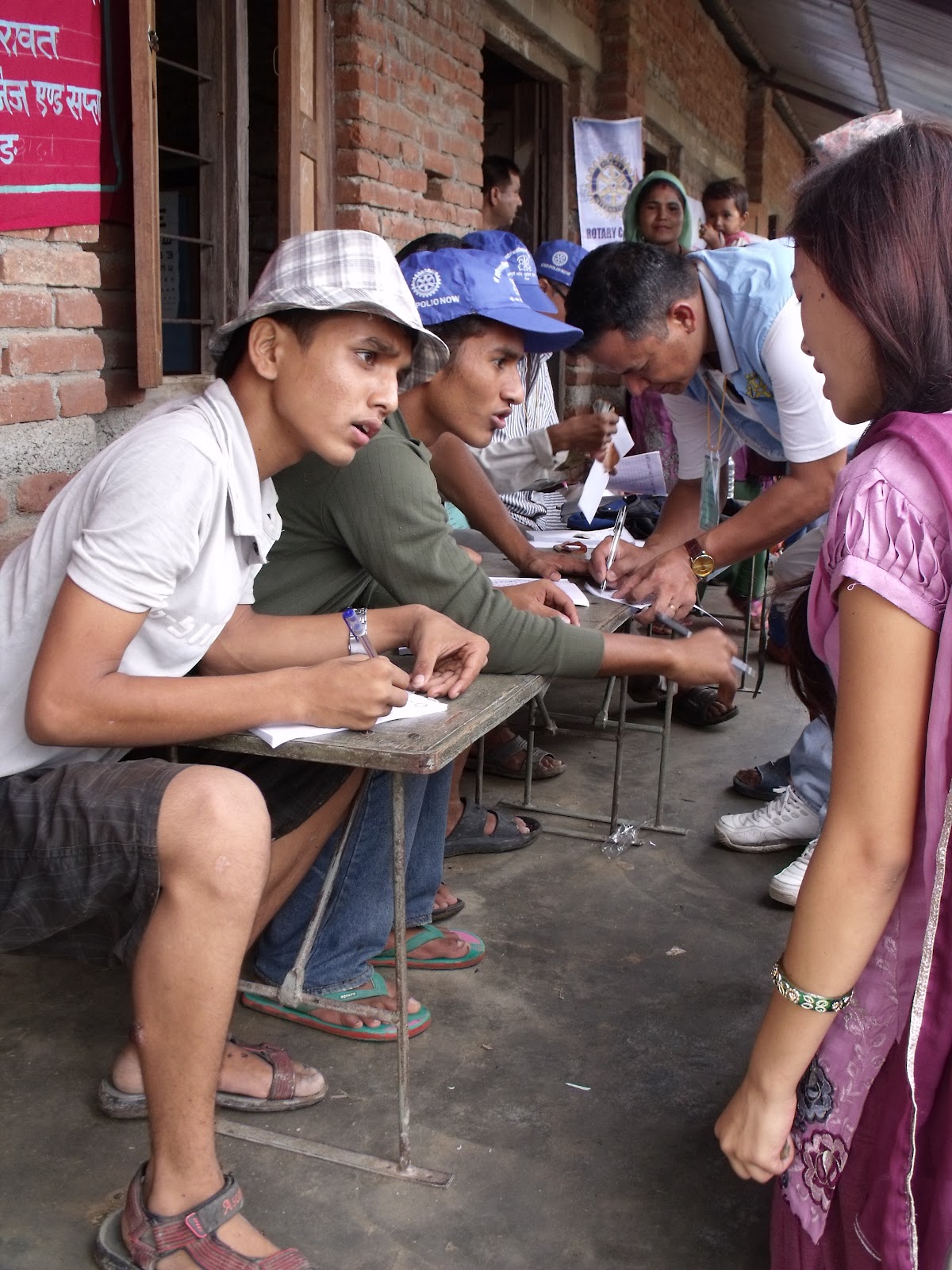
Registration of patients
Consultation with GPs - main complaints were joint pain, arthritis and stomach ulcers.

A woman suffereing from uterus prolapse

The camp team

Our one optometrist did an amazing job of seeing around 250 patients a day

Educational posters

Monday, July 9, 2012

Notes on a health camp


We are currently on a health camp in the mid-western part of Nepal. The camp started with two days in the beautiful mountain village of Argarli in the Palpa region, we then moved down onto the plains for a couple of days in some small villages outside of the city of Butwal and we are currently in the Dang area for the final four days. The camps are proving very popular with the locals, providing basic health check-ups, dental care, women’s health and eye care. Medicine is provided free of cost.  Most of the doctors come from our area, with a couple from Kathmandu. They are a great bunch of dedicated professionals who love a beer afterwards too!


We spend most of our time working in the eye team, screening people to be seen by the optometrist and providing glasses.  We try to get time to visit our friends in the other teams but the eye tests are very popular with the locals with the biggest line by far. The work can be very tiring but there are some moments of humour as well…

… One time Ashok was laughing as he overheard some of the locals calling their friends on the phone to say ‘The American doctors are here come quickly!’ Despite the fact that we are the least qualified people here.

… There is the moment in some of the villages where we realise that the reason no one seems to understand what is going on is that the villagers don’t speak Nepali but rather their local language. This can make translation very tricky…

…There is always time for tea…

…When we went to a restaurant one evening we were served warm beer and chilled cucumber. Seems to me they got that one the wrong way around…

… It is the hot season on the plains, even after a ‘cold’ shower you sweat just sitting still in the shade…

… The time I asked our bus drivers assistant to help keep curious children away from the door as they were blocking the light. He took to the task with great gusto running after the kids he could find, and when he couldn’t find some he went looking for more , I only wanted them kept back a couple of metres…

These camps are a great way to bring healthcare to places and people who rarely receive any. There are many people who are poorly educated and illiterate, meaning that they will not go seek out healthcare for illnesses as they are unaware that treatment is available. Even if there is a hospital in a local town many villagers do not know to go get care or they cannot afford the cost. It is also a great way for some of the younger doctors to gain experience and to go and see some beautiful places well off the tourist track.

Monday, July 2, 2012

Argali Health Camp

We have just completed 2 days of health camp in Argali Village, where with our team of doctors we set up a mobile clinic in the local primary school. Our team of around 20 included; general doctors, women’s health doctors, dentists, an optometrist and pharmacists. Each discipline sets up a basic clinic in one of the classrooms, and in the cramped space organised chaos reigned for 2 days. There were lots of local volunteers to assist with registering patients, and to ensure it all ran smoothly.

Argali, with a population of around 6000 has only one medical professional at present – a Community Medical Assistant – meaning they have had 18 months of training for the job.  Although Argali is only 2 hours drive from Tansen, where good medical facilities exist, we definitely saw the need for better health care locally.  The good news is that the government is building a facility that will eventually have one doctor and one nurse working there.  Over the two days we saw a total of 1370 patients, our one optometrists did an amazing job to see 302 patients in one day!
Overnight we were lucky to be hosted by the locals in their homes (there are no hotels there) and we were quite simply spoilt by their hospitality.  We were given the best room in the house to sleep in, despite our protests (we are still not sure if it was the master bedroom), and upon waking a cup of hot tea was waiting.  We had a great time communicating with our limited Nepali and our hosts limited english, that definately made for many laughs!  The village joined together to formally welcome and farewell us and to cook us all our meals – a delicious dal bhat of course. 

Argali village, about 2 hours drive outside of Tansen along the steep winding hillside road is a beautiful peaceful village, nestled amongst the mountains.  It showed us a side of Nepal that we don’t see often, as most of the projects we have been involved in to date have been in the Kavre District and Terai region of Nepal. It was also a welcome relief from the sticky heat of the Terai – a sweltering, and de-motivating 35 degrees at the moment.  Argali was the first of many locations for our mobile health camp, so we will keep you posted on how we get on.

Queues waiting to see the optometrist

General doctors consultations

Saturday, June 30, 2012

Travelling to Health Camp

Yesterday we spent a full day travelling to the western part of Nepal with a team of Nepali doctors, pharmacists, dentists and optometrists ready for a 2 week long health camp.  What a day! We had a chartered bus for the team – jam packed full of gear and people – that in typical Nepali style had absolutely no leg room. Quite simply neither of us could fit in the seat – except at an angle. The trip of around 300 km took 15 or so hours, departing at 8am from Banepa it was 11pm before we got to Tansen.  Perhaps a 3 hour trip were we back in NZ…

Along the way we passed lots of queues for petrol – there have been a lot of shortages lately and it is not uncommon to see 20+ vehicles parked beside the petrol station waiting for it to start distributing again. Somehow everyone knows where to wait, and where not to as some petrol stations have simply shut up indefinitely as business is too difficult with the irregular supply.  In Tansen the petrol station (consisting of 30 odd drums) received a delivery as we arrived, and this morning there were 100+ motorbikes stretching around the corner and out of sight waiting to be filled up.  Fortunately, we managed to fill up without too much delay.
We broke down once, fortunately before it got dark, and outside a small town. A mechanic was summoned from down the road, and while we patiently looked on he fixed the bus.

So while we progressed slowly we stopped occasionally to pick up supplies, and for food and toilet stops.  In the sticky 30 degree heat we stopped for a lunch of Dal bhat (all you can eat rice and lentils), and arriving in Tansen late at night we were once again given dal bhat. Really all we felt like at that stage was cold beer!
All in a days travel in Nepal …

Wednesday, June 27, 2012

Checking up on Baluwa village

We took advantage of a break in the monsoon rains to take some of our friends out to Baluwa village to check on progress of some projects there - sponsored by Rotary Clubs in Nepal (Dhulikhel) and New Zealand (Tauranga Te Papa, Matamata, Papamoa). It was some of the other guys first trip to the small rural villages and they were in for a treat! As we got out of the cars at the school we discovered that the children were so grateful for the help that they have received that they had formed a clapping guard of honour for us. This bought huge smiles to all our faces and we all had a ball with the kids. A truely humbling experience.

All smiles as we arrive at the school
Some village ladies who served up tea
This child was born with club feet, this mother is mute and has two other children. A New Zealand Rotarian has sponsered the cost of corrective casts ($150).


We went for a look at some houses built by a group of New Zealanders in the surrounding village and shared a cup of tea with the locals while we discussed further projects in the village. We also inspected the site of a new high school being built by the villagers. The great thing about this is that the villagers are doing a lot of the planning and construction themselves and we are moving to more of an advisory role, This means than we are equipping people with the tools to help themselves and not creating a cycle of dependence.

The site of the new High school

This is Sankers brother, Sanker is the boy who we helped get treatment for a tumor in his groin. He is now working in Kathmandu and helping his brothers attend school.
It was a great morning and good to share some of our work with our friends. Also good to catch up on some of the great work that has been done while we have been away. 

Tuesday, June 26, 2012

SOS orphange

We were lucky enough to get to know the good folk at SOS childrens orphanage. This is a great organization that works with some of the many orphans here in Nepal. It is large organization with 9 different sites in Nepal. The Kavre, Banepa facility houses 140 children in 14 homes each with 10 children of different sexes and ages, and complete with its own house mother. This provides a family enviroment for the children to grow up in. The children are supported though university with many choosing to sponser the next generation of children in SOS once they get jobs.

The children are funded by overseas and Nepali sponsorship with many overseas sponsors sadly having to give up their sponsorship due to the financial suituation. We were invited to an event staged to encourage the local business community to pick up the slack created by the overseas funding drying up. We were treated to performances by the students and to a delicious lunch in one of the houses. I can say that my host house Bagmati looked after us very well indeed.


Some of the children performing


The boys room in Bagmati house
It is very inspiring to see so many people dedicated to providing a loving home to some of the needy children of Nepal. This is a very trustworthy and worthwhile organization that is in need of sponsorship so if you want to make a massive difference to some childrens lives get in touch with us and we will let yo know what you can do.